Description
The innovative Channel Blanket hybrid mode of the TQ1402 enables optimized wireless networking for all environments. By allowing simultaneous multi-channel and single-channel WLAN connectivity from the same access point, network administrators can combine the performance attributes of the two architectures to best suit their specific deployment requirements.
The TQ1402 has a single 2.4GHz radio and a single 5GHz IEEE 802.11ac radios, and supports Multi-User Multiple Input and Multiple Output (MU-MIMO), allowing multiple clients to send and receive data at the same time, substantially increasing throughput. Combined with a comprehensive feature-set, the APs provide a superior wireless solution for customers from SMBs to large Enterprises.
Smaller businesses can operate the TQ1402 in standalone mode, using its intuitive web-based user interface. For larger installations it can be managed by Allied Telesis Autonomous Wave Control (AWC). With AWC, the wireless network is regularly analyzed, and APs are dynamically updated to reduce interference, minimize coverage gaps, and optimize performance – all with no user intervention. Allied Telesis network management platform, Vista Manager EX, has an AWC wireless management plugin that supports up to 3,000 APs.
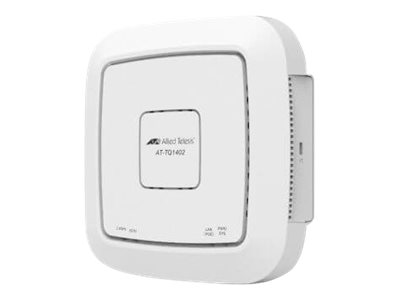
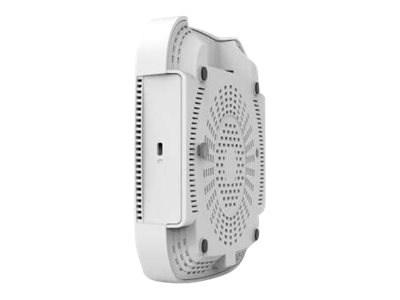
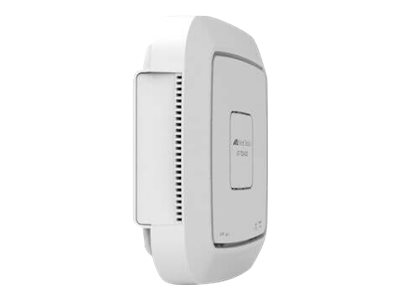
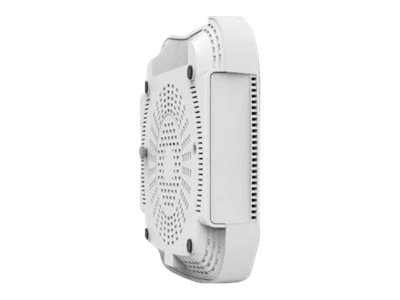
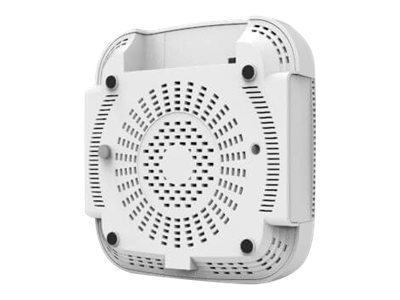
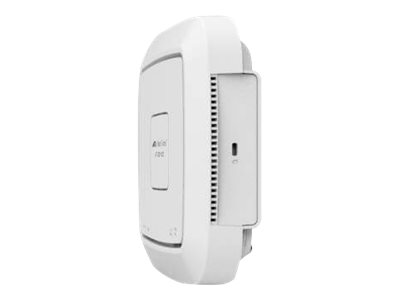
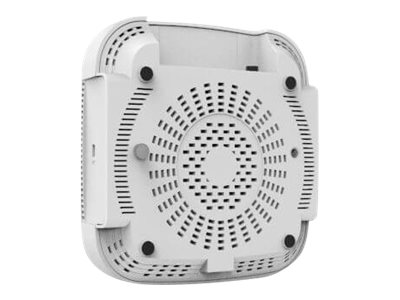
Flexible deployment options enable easy installation, with the TQ1402 able to be used on the desktop or mounted on a wall or ceiling. Power may be supplied by Power over Ethernet, for the simplicity of having the Ethernet network connect and power the APs, or by an optional AC power adapter.
- Channel Blanket Hybrid Operation
- IEEE 802.11ac Wave 2
- Dual-radio, with Band Steering
- IEEE 802.11e Wireless Multimedia (WMM)
- IEEE 802.11i (security)
- Virtual APs with Multiple SSIDs
- Captive Portal
- Dynamic VLANs
- Graphical User Interface
- Airtime Fairness
- Fast Roaming
- Channel Blanket Hybrid Operation
The TQ1402 supports operation in multi-channel, single-channel (Channel Blanket) and hybrid (multi-channel and Channel Blanket) modes, for the most flexible wireless solution available. Multi-channel operation provides maximum throughput for high-bandwidth clients, while Channel Blanket operation supports seamless roaming for dynamic environments like warehouses and hospitals, as all APs appear as a single virtual AP. Hybrid mode combines the best of both architectures, enabling an innovative wireless solution that maximizes performance for a superior user experience. - IEEE 802.11ac Wave 2
IEEE 802.11ac Wave 2 wireless connectivity delivers Gigabit performance and throughput. In crowded wireless environments, efficient bandwidth distribution is important; IEEE 802.11ac Wave 2 achieves efficiency and robustness, using Multi-user MIMO technology. Unlike traditional Single-user MIMO networks where devices are served sequentially, Multi-user MIMO simultaneously communicates to multiple clients at once, reducing contention and improving capacity and throughput by up to three times. Multi-user MIMO uses beamforming, where the AP focuses wireless signal towards connected devices, rather than simply radiating the signal evenly. This improves range and speed for each user, and reduces interference for the best possible connection. - Dual-radio, with Band Steering
The TQ1402 contains two IEEE 802.11 2ss radios to enable concurrent Wi-Fi communications: one at 2.4GHz band, and one at 5GHz band. This alleviates network congestion and isolates any legacy client devices affecting performance. Band steering prompts newly connecting devices to use a band with little current congestion to distribute wireless traffic, provide maximum throughput, and the best user experience. - IEEE 802.11e Wireless Multimedia (WMM)
Quality of Service (QoS) on the wireless network optimizes the performance of voice, video, and data applications, as each has different latency, bandwidth and performance requirements. QoS traffic prioritization ensues the timely delivery of these services. - IEEE 802.11i (security)
This feature set facilitates strong encryption, authentication and key management strategies, guaranteeing data and system security. In addition to Counter Mode with Cipher Block Chaining Message Authentication Code Protocol (CCMP), IEEE 802.1X key distribution via RADIUS controls access to the network. - Virtual APs with Multiple SSIDs
The TQ1402 supports Virtual AP (VAP) functionality, with the assignment of different SSIDs and security policies for each VAP on the physical device.
VAPs can be mapped to VLANs for logical network separation and improved throughput. Enable communication by application, function or users. - Captive Portal
Manage user access to the Wi-Fi network with captive portal. New users are taken to a login page ensuring they must authenticate before gaining access to the wireless network, and any online resources and applications. - Dynamic VLANs
Dynamic VLANs simplify management by enabling users to be separated on different VLANs according to rules defined in a centralized user database. When a user connects, their credentials are checked and the VLAN assigned automatically to the AP. An external RADIUS server is supported and a secondary RADIUS server can also be specified for redundancy. - Graphical User Interface
The web-based user interface is user friendly and intuitive, minimizing training needs, and allowing easy management and monitoring of a single AP. AWC enables management of multiple APs, and automatic wireless network optimization. - Airtime Fairness
Airtime Fairness equally assigns airtime to each connected client, to ensure fair and predictable sharing of bandwidth. This feature prevents any client from monopolizing the bandwidth when transferring a large amount of data, and ensures consistent performance for all users. - Fast Roaming
Fast Roaming with 802.11k, 802.11v, and 802.11r optimizes the process of discovering and selecting the best available AP in a Wi-Fi network, and establishes rapid connectivity for users to seamlessly move between APs.
Users will experience a consistent wireless connection as the APs exchange security keys, so the client device does not need to re-authenticate on the RADIUS server as they roam.
Main Specifications
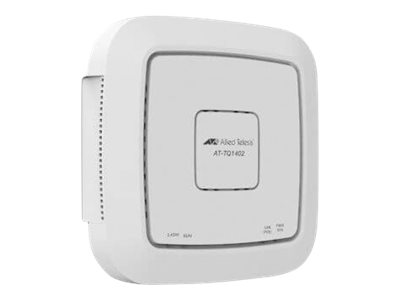
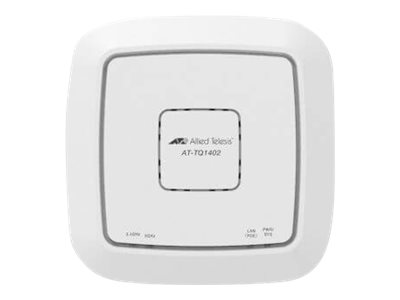
Product Description | Allied Telesis AT TQ1402 – radio access point – Wi-Fi 5 |
Device Type | Radio access point |
Form Factor | External |
Data Link Protocol | IEEE 802.11b, IEEE 802.11a, IEEE 802.11g, IEEE 802.11n, IEEE 802.11ac Wave 2 |
Frequency Band | 2.4 GHz, 5 GHz |
Power Over Ethernet (PoE) Supported | PoE |
Power | AC 120/230 V (50/60 Hz) |
Dimensions (WxDxH) | 16.3 cm x 16.5 cm x 4.3 cm |
Weight | 430 g |
Extended Specifications
General
Device Type | Radio access point |
|---|
Width | 16.3 cm |
|---|
Depth | 16.5 cm |
|---|
Height | 4.3 cm |
|---|
Weight | 430 g |
|---|
Networking
Form Factor | External |
|---|
Connectivity Technology | Wireless |
|---|
Data Transfer Rate | 1.167 Gbps |
|---|
Line Coding Format | DBPSK, DQPSK, CCK, 64 QAM, 256 QAM, BPSK, QPSK, 16 QAM, OFDM, DSSS |
|---|
Data Link Protocol | IEEE 802.11b, IEEE 802.11a, IEEE 802.11g, IEEE 802.11n, IEEE 802.11ac Wave 2 |
|---|
Network / Transport Protocol | CSMA/CA |
|---|
Remote Management Protocol | SNMP 1, SNMP 2c, HTTP, HTTPS |
|---|
Frequency Band | 2.4 GHz, 5 GHz |
|---|
Features | VLAN support, MAC address filtering, Wi-Fi Multimedia (WMM) support, Quality of Service (QoS), Multiple SSID support, Dynamic VLAN Support (GVRP), Captive Portal, band steering, Fast Roaming, Airtime Fairness, client isolation, 2×2:2 MU-MIMO technology |
|---|
Encryption Algorithm | AES, 128-bit WEP, 64-bit WEP, PEAP, TKIP, WPA, WPA2, WPA-Enterprise, WPA2-Enterprise |
|---|
Authentication Method | RADIUS |
|---|
Compliant Standards | IEEE 802.3, IEEE 802.3u, IEEE 802.1Q, IEEE 802.3ab, IEEE 802.11b, IEEE 802.11a, IEEE 802.3x, IEEE 802.11g, IEEE 802.1x, IEEE 802.11i, IEEE 802.11e, IEEE 802.11n, IEEE 802.11k, IEEE 802.3at, IEEE 802.11r, IEEE 802.11v, IEEE 802.11ac Wave 2, IEEE 802.11ss |
|---|
Aerial
Antenna | Internal |
|---|
Directivity | Omni-directional |
|---|
Gain Level | 3.7 dBi |
|---|
Expansion / Connectivity
Interfaces | 1 x 1000Base-T (PoE) – RJ-45 |
|---|
Miscellaneous
Compliant Standards | EN 61000-3-2, ICES-003, EN 61000-3-3, EN55024, EN55022 Class B, RSS-210, RSS-102, EN 61000-4-4, EN 61000-4-2, EN 61000-4-3, EN 61000-4-6, IC, EN 61000-4-5, FCC, EN 61000-4-11, FCC Part 2, UL 60950-1, IEC 60950-1, EN 60950-1, AS/NZS 4268, EN 60601-1-2, CSA C22.2 No. 60950-1, CISPR 11, TUV T, KC, EAC, RCM, EN 300 328, AS/NZS CISPR 22 Class B, EN 301 489-1, EN 301 893, EN 301 489-17 |
|---|
Power
Power Over Ethernet (PoE) Supported | PoE |
|---|
Voltage Required | AC 120/230 V (50/60 Hz) |
|---|
Power Consumption Operational | 12 watt |
|---|
Environmental Parameters
Min Operating Temperature | 0 °C |
|---|
Max Operating Temperature | 50 °C |
|---|
Humidity Range Operating | 90% (non-condensing) |
|---|
Only logged in customers who have purchased this product may leave a review.


Reviews
There are no reviews yet.